Why should you trust the data on Watchdog?
One New Jersey address can lead to hundreds of useful property data points. Watchdog brings them together from official state, county and municipal sources so you do not have to spend hours searching for them yourself.
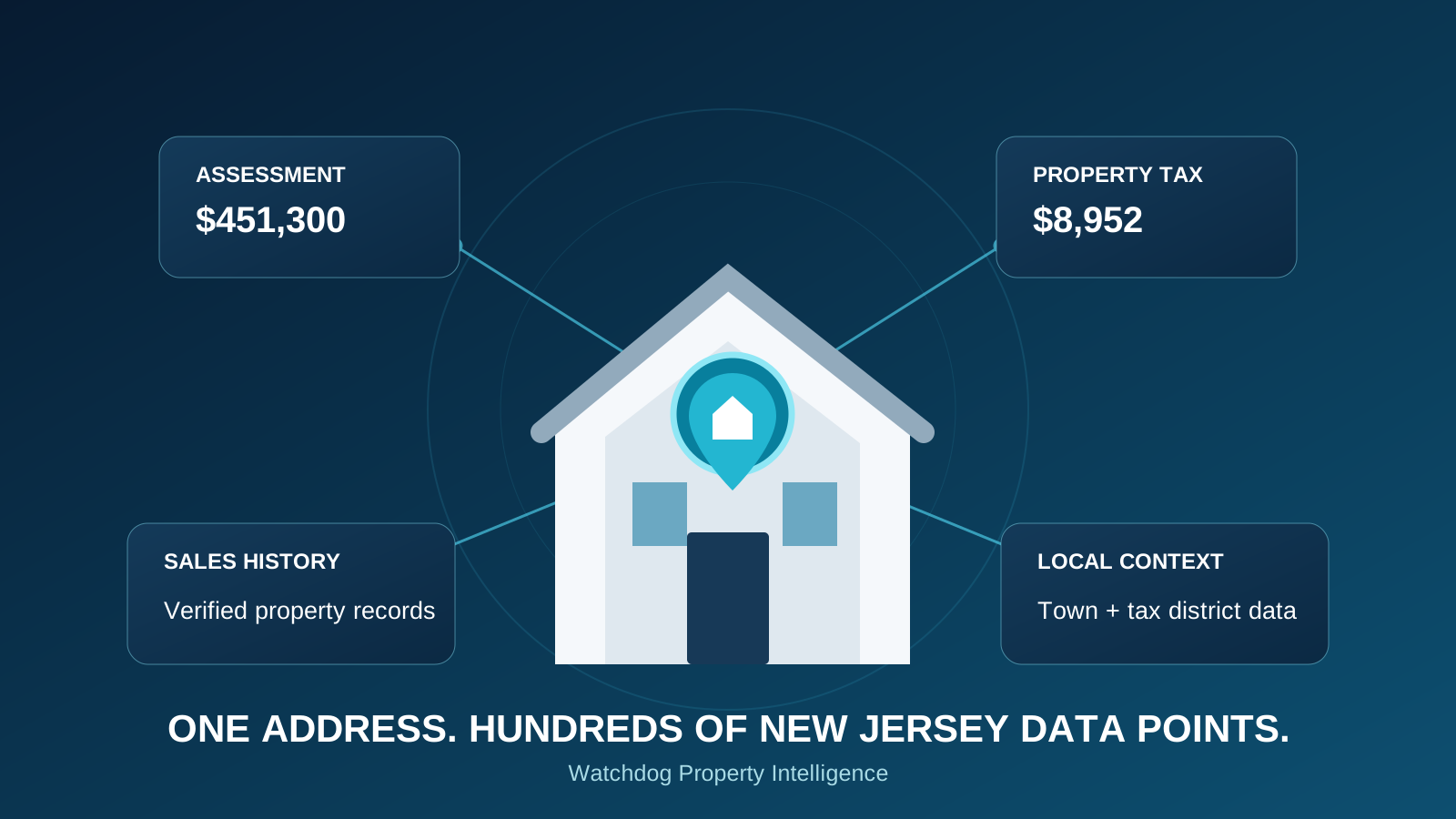
Looking up a property in New Jersey should be simple. In practice, it rarely is.
You may find the assessment in one place, the tax rate somewhere else, a sale record in another file, and the town’s equalization information on a state spreadsheet. Then there are exemptions, deductions, revaluation records, appeal rules, municipal details and years of historical data.
None of that information is necessarily hidden. The problem is that it is scattered.
Watchdog is built to solve that problem. Type one New Jersey address and we organize the property information we can verify around that address into one place.
The data starts with New Jersey, not with a mystery estimate
Trust starts with knowing where a number came from.
Watchdog is built around official New Jersey public records and government data. For local property taxation, one of the most important sources is the New Jersey Division of Taxation. The state publishes Property Assessment List data through the MOD-IV system, along with sales files, tax rates, equalization tables, common level ranges, appeal statistics and other local property tax records.
The state describes MOD-IV as the system used to maintain and update assessment records and produce the tax lists required by law. Those tax lists identify parcels and include taxable values and descriptive property data.
That is very different from starting with an unexplained number from a third-party website and asking you to trust it.
One address can connect a lot of separate records
A property is more than a market value.
Depending on the property and the records available, Watchdog can organize hundreds of individual facts, calculations and signals around one address. That can include assessment information, property taxes, land and improvement values, property class, sales history, municipal tax information, equalization data, exemptions or deductions, revaluation activity and historical changes.
Some information comes directly from an official record. Other Watchdog data points are calculations or signals created from those records. We believe that distinction matters.
If Watchdog calculates a ratio, trend, comparison or risk signal, the underlying facts should still trace back to the source data used to create it. The goal is not to replace the public record. The goal is to make the public record much easier to use.
Why not just search the government websites yourself?
You can, and sometimes you should.
The New Jersey Division of Taxation alone publishes MOD-IV assessment files, SR1A sales data, general and effective tax rates, county equalization tables, common level ranges, coefficient of deviation studies and other property tax information. County and municipal offices maintain additional records.
For one homeowner checking one question, opening a few government pages may be enough.
For an investor reviewing multiple properties, a real estate professional preparing for a client call, an attorney examining an assessment, or an organization working across many addresses, repeating that process becomes work.
Watchdog turns the address into the starting point. Instead of asking you to know which agency has which spreadsheet, we work to connect the relevant records to the property.
Useful for one homeowner and useful at professional scale
A homeowner may want a simple answer: What is my assessment? What did I pay in taxes? Does my town have a revaluation coming? How does my assessment compare with the market?
A professional may need much more.
Real estate agents can use property and municipal context before a listing or buyer conversation. Investors can compare tax burden and assessment signals across opportunities. Attorneys and tax professionals can get a faster starting point for research. Lenders, appraisers and larger firms can use the same underlying property intelligence when they need to understand more than the asking price.
The address stays the same. The depth of the question changes.
We do not want you to trust Watchdog because we say so
A data platform should be able to show its work.
That is why Watchdog articles link to primary New Jersey sources when we report a state rule, deadline or program change. It is also why our property intelligence is being built around source awareness, update timing and clear separation between official facts and Watchdog analysis.
Government records can contain errors. Records can also update at different times, and a recently filed transaction may not appear immediately in every system. Watchdog cannot make the underlying public record perfect.
What we can do is avoid pretending those limitations do not exist. When a decision has legal, tax or financial consequences, the original government record and the appropriate professional should remain the final authority.
New Jersey property data should not require a scavenger hunt
The information needed to understand a property often already exists. It just was not designed to live on one screen.
That is the opportunity behind Watchdog.
We take locally relevant New Jersey property information, organize it around a real address, add useful context and calculations, and make it easier to understand. A homeowner should be able to use it. So should a real estate professional. So should a firm evaluating properties at a much larger scale.
One address. Hundreds of data points. New Jersey sources behind the facts.
That is what Watchdog is being built to deliver.
Search a New Jersey property on Watchdog and start with the address instead of the scavenger hunt.
Primary sources: NJ Division of Taxation Statistical Information, including MOD-IV Property Assessment Lists, SR1A sales files, tax rates, equalization data and common level ranges; NJ Division of Taxation Local Property Tax Reference Materials; New Jersey MOD-IV Handbook.
Frequently asked questions
Where does Watchdog get New Jersey property data?
Watchdog is built around official New Jersey public records and government sources, including Division of Taxation property assessment, sales, tax rate and equalization data, plus relevant county and municipal records.
Does Watchdog replace the official government record?
No. Watchdog organizes and explains public property information and can create calculations or signals from it. For legal, tax or financial decisions, the original government record remains the final authority.
Why use Watchdog instead of searching government websites myself?
You can search the source sites directly. Watchdog is designed to save time by organizing information that may otherwise require multiple state, county and municipal searches around one property address.
Is Watchdog only for homeowners?
No. It is designed to be understandable for homeowners while providing deeper property intelligence that can also help real estate professionals, investors, attorneys, lenders, appraisers and organizations researching New Jersey properties.
Assessment, tax and property context for any New Jersey address.
Open Watchdog